


The goal at any major championship is to get in the final group on Sunday. That means you're either in the lead, tied for the lead or pretty close to the lead with 18 holes to play.
However, it's particularly important to get in the final pairing on Sunday at the Masters Tournament.
The Masters winner has emerged from the final pairing of the final round in 29 of the last 34 years. While that 85 percent clip is a strong trend, recent Masters history has bucked the trend.
From 1991-2010, the Masters winner came from the final pairing in 19 of 20 years. Zach Johnson was the only exception in that run, when he won at 1-over 289 in 2007 from the third-to-last group. Then from 2011-13, Charl Schwartzel, Bubba Watson and Adam Scott all won from outside the final pairing.
In 2014 and '15, however, both Bubba Watson and Jordan Spieth won from the last group on Sunday. Since then, the trend has largely held true. It's just the way that it is at the Masters, so it's better to assume that will be the case again this year rather than assuming some fantastical comeback is about to happen.
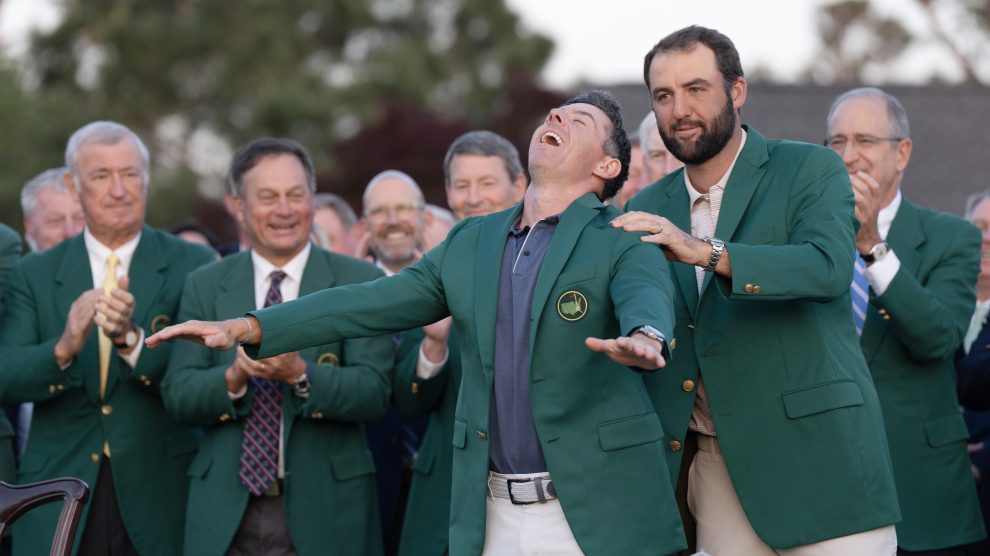
If the trend holds in 2026, then Rory McIlroy will be the 4th back-to-back Masters winner after completing the career Grand Slam in 2025, or Cameron Young is about to become the third-consecutive winner of The Players to win the green jacket a month later.
However, the biggest Masters comeback after 54 holes in Masters history is eight shots, and it belongs to Jack Burke Jr., who overcame that deficit against then amateur Ken Venturi in the 1956 Masters.
Of course, that would then put any player at 3-under 213 or better through 54 holes within historical earshot of coming back. In that case, a total of 28 players on Sunday have at least a remote chance of winning the green jacket and everything that comes with being a Masters champion.
