



Open Championship coverage this year will be a lot different for me. I’ll be live from the UK.
“Grazie dio!” as they say in Italian.
Better still, plans include not only a deep dive into the the Open Rota venues but a smattering of the best of the rest as well. Not just say, St. Andrews, Troon, and St. George’s, but also St. Enodoc, Western Gailes, and Deal. I'm not just going to collect famous courses, I'm going to study the arc of golf design and history as it happened over a century and a half ago. And I'll open up a whole new continent of friends and colleagues.
This isn’t just an assignment. It’s justice and a fight back. As my editors, my doctors, and my friends all agreed, “You’ve been through a lot lately, Jay.” Or as I like to say, when the world takes something from you, you go take something right back. For me, England first. The Alps second. Some Seven Summits third.

England’s Golf Coast, Part One: Royal Lytham and St. Annes, Royal Liverpool, and Formby Golf Club
This year, the plan involves not only covering and reporting about the Open, but also – finally! – traveling to, playing with and meeting with the wonderful members of the great courses of the Isles. Off we go -- but where to start?! My itinerary is as unpredictable as riding around in Dr. Who’s rickety TARDIS.
The factors most in play in planning my itinerary this time were short notice to book airfare, golf, and hotels, finding a short window for getting in my golf rounds once we arrived, and time to write. I’d be limited to ground transport upon landing, so playing courses in close proximity was imperative, as was maximizing the quality of golf.
Rough drafts of trips were generated with those parameters: Dublin, Southern England, Northern England, and the Turnberry area of Scotland were all outlined and researched. In the end, Northern England -- England’s fabled Golf Coast -- won out, primarily due to both availability and ergonomics. Besides, you’re supposed to do this trip by train. It’s the custom.
Royal Birkdale, the crown prince of England’s Rota venues was, lamentably, closed for play from the end of June to the end of July, but Royal Lytham and St. Annes, every bit as venerable and certainly more difficult than its Southport sister, had a smattering of tee times on back-to-back days early-to-mid-week.
Royal Liverpool, in the nearby town of Hoylake, was a mere hop, skip and jump away by the same train on a different line (the Northern Line versus the Wirrel Line). With its remarkable resurgence and pedigreed history, it was both close and equally imperative as either Lytham or Birkdale. And in between the two lay Formby – as in Formby Golf Club, the town of Formby, and the Formby Hall resort, ancestral home course of Tommy Fleetwood.
So Lytham twice, Formby and Hoylake. This works well geographically and ergonomically as we plan to play Birkdale and its Southport area friends – the courses we missed this time – the next time we go over, such wonderful links as West Lancashire, Wallasey, Southport, and Hillside.
In between there will be interviews with British golf architects, club historians, greens chairmen, golf professionals, and a deep dive into all of English golf’s richest treasures.
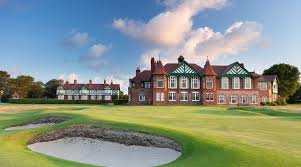
Royal Lytham and St. Annes
Talk about starting with a bang! Is there a more difficult Open Rota course than Lytham when the wind is up? British commentators like Peter Alliss and Nick Faldo think so. At one point there were as many as 207 bunkers on the golf course, all seemingly exactly where a well-struck golf shot should end up. Indeed, Lytham’s most identified by its bunkering – a mix of penal and strategic positioning.
“We have added some new ones for you to try, Jay!” boasted a cheeky martin Ebert, one of the golf architects working on Lytham to renovate it for both next year’s AIG Women’s Open, and for Lytham’s next time hosting the Open, to be announced soon, maybe even during Championship week.
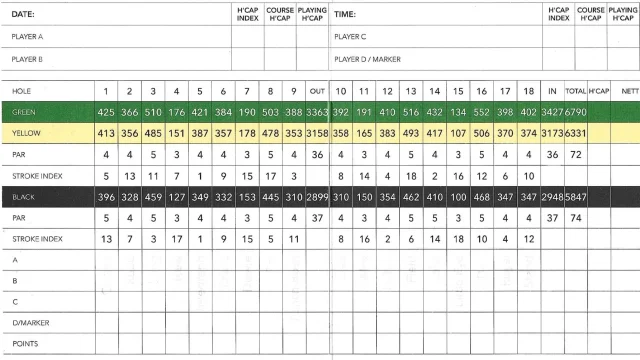
Lytham is long for regulation golfers, over 6,700 yards from the medal tees, but relatively short for a major championship venue at just 7,200-ish yards for tournament play. Par is reduced from 71 to 70 for big events. The sixth hole – the first of two back-to-back par 5s at Lytham is played as a 500-plus-yard par 4.
Therein also lies some of the beauty, charm, and challenge of Lytham, its unique and beguiling routing. Few, if any, courses start with a par 3, but Lytham’s original short par-4 first was reduced to a par 3 decades ago, and so begins an asymmetric sequencing that sees all par 3s and par 5s completed by hole 12, the last of four par-3s.
The final six par 4s meander every which way coming home, meaning that the long stretch home features constantly changing wind directions from shot to shot. With no wind, Lytham can produce low scores. David Duval closed 65-67 to win the Open Championship there in 2001. But Adam Scott fell out of the sky like Icarus in 2012, losing a four-shot lead with four holes to play and dropping the claret jug in the ground for Ernie Els to pick up.
Lytham has hosted 11 Open Championships since Bobby Jones himself won the first contested there in 1926. (He won the U.S, Open the same year at Scioto in Columbus, Ohio, the same club that would produce Jack Nicklaus.) Perhaps most famously, Spain's Seve Ballesteros repeated at Lytham as Open Champion, winning in 1979 and then again when the Open returned to Lytham in 1988. He reigns supreme among the unquestionably strong lineup of shotmakers that triumph at Lytham: shotmakers, not bombers.

While never actually touching the Irish Sea at any point, the course sits atop sandy soil as it winds its way through the charming red-brick neighborhood, just within touching distance of St Annes Beach. Rooms for visiting golfers in the Dormie House overlook the first fairway and are named for great golf champions that won at Lytham.
Royal Liverpool
Royal Liverpool Golf Club is known simply as Hoylake to its friends because it is actually situated in the town of Hoylake, 10 miles from Liverpool. While the course sits atop sandy loam deposited by the adjacent River Dee, its layout is, at present, both a contradiction and a work in progress. The club is ancient and storied, and hosted numerous opens until 1957, until it was shunned for nearly 40 years for reasons spanning both ergonomics and course quality.
Roughly two thirds of the course was a former racetrack, and the flat landscape of those holes reflects that history...until you get off the fairway, and then who knows what kind of stance and lie you’ll have. While most of the original Harry Colt greens are gone, the newer greens built by several hands over many decades have interesting internal contours, so challenge is preserved.

Many hands have worked on Hoylake since Harry Colt’s day, and we will interview some of them in the coming weeks. Martin Ebert and Tom MacKenzie have both redesigned holes here as well as added aesthetic touches such as the new exposed sand scrapes.
Hoylake also re-sequences its holes for the Open Championship. In order to finish with a par 5 -- and perhaps a dramatic eagle -- the pros start their round on the 17th hole, and play in order after that, until finishing on the 16th.
Royal Liverpool has crowned golf royalty nearly every time it has hosted an Open: Bobby Jones, Tiger Woods, Rory McIlroy, Walter Hagen, Peter Thomson, and J.H. Taylor among others. Just two years ago, journeyman and veteran pro Brian Harman won over a much greener and more lush links than the dry, dusty Hoylake of 2006 and 2014.

Formby Golf Club
“What’s Foamy?! I don’t wanna play Foamy!”
That’s what one of my lunkhead golf buddies shouted over the phone when I told him the itinerary. I held firm, and of course a day later when he went to the Internet and saw that – contrary to his hurried assumption – Formby is not “some new, modern thing” as he feared, but a storied, venerable, and brilliant heathland links with aspects of dunescape and parkland elements. All three blend seamlessly into one of the most beloved links in the UK or Ireland and one that has hosted marquee international and English competitions for over a century.
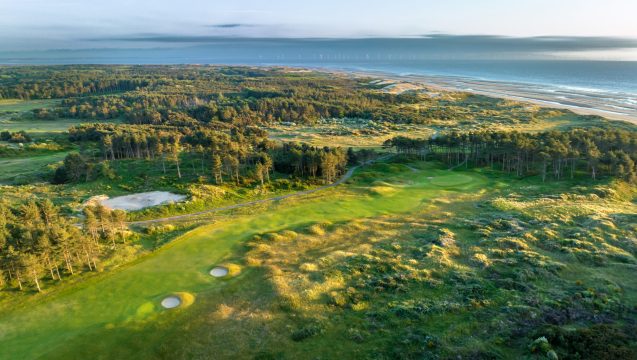
Let’s dispel some confusion as well. The Formby Golf Club is the venerable home to so many storied English tournaments such as the Walker Cup and the Amateur Championship. It’s not to be confused with the Formby Ladies Club, a course that runs at times within and at times adjacent to the Formby Golf Club. Just down the road is Formby Hall Resort, where Tommy Fleetwood played as a junior.

Formby is a smashing links! Part rumpled heaving sea fairways amidst gargantuan sun-dappled dunes, part heathery heathland by the shores of the Irish Sea, it was also the site where one of golf’s most curious figures entered into history – Maurice Fltcroft, England's worst golfer and a proper rejoinder to Angelo Spagnolo, who shot 257 at Sawgrass. Flitcroft was banned from Open Championship qualifying after shooting 121 and raising a ruckus with his confrontational demeanor. So for years he would enter under fake names and wearing disguises. The R&A even employed a handwriting expert to analyze entry sheets to watch out for him.
While there, I'll ride the rail like a local, visit Beatles country like a real rock and roller, and try to at least beat Flitcroft’s scores. The next great step is waiting, and best of all you can play them all, too.
