


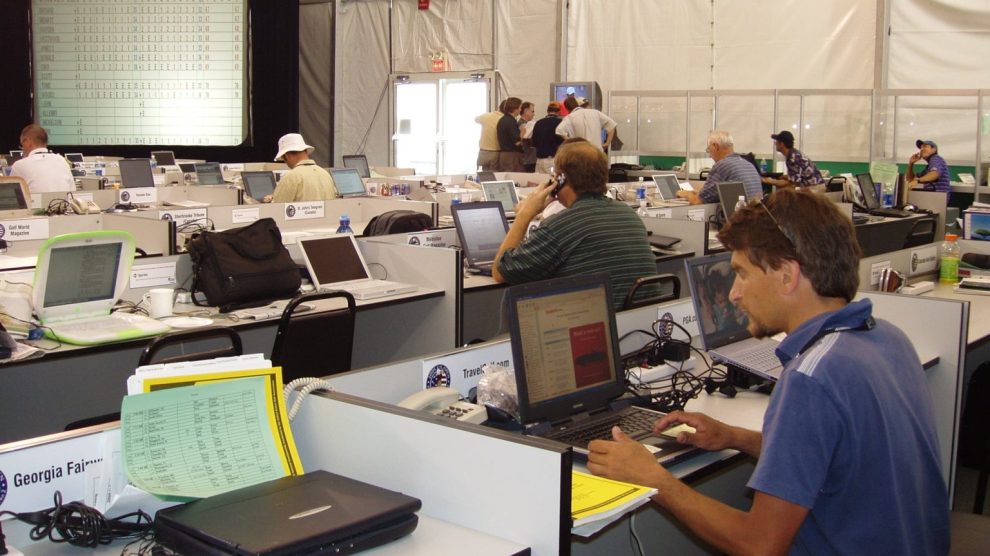
I remember the news hitting me like a horrible break-up -- a break-up with a supermodel: Cybergolf, my magazine home for a decade, was closing up shop.
It was summer 2015. My plane was wheels down, the car was wheeling west towards Seattle and Chambers Bay, and I was deep in U.S. Open mode. But the phone call from editor-in-chief Jeff Shelley breaking the news was devastating. The magazine would publish its last issue with this U.S. Open. Undaunted, Golf News Net snapped me up in time for the PGA at Whistling Straits. Thank you again, Ryan Ballengee. And thank you Jeff Shelley for ten epic years.
The week at Chambers was anything but a funeral, though. For openers, I stayed for that week on the biggest boat in the Seattle marina, a monster yacht dwarfing everything around it. It stood whole decks above everything parked in the bay. I couldn’t resist getting behind the wheel and channeling my inner Al Czervik, shouting, “Hey Smells! My dinghy’s bigger than your whole boat! Save me a parking space, I’m coming in!”
My quarters weren’t quite as large. As I was smallest, I got to sleep in the forepeak. At an angle. With my feet above my head. Still, it was worth it.
Chambers Bay took a bad rep that week. For no good reason, many in the media -- without any knowledge of drainage or turfgrass management -- blamed the golf course for splotchy greens. “Chambers is terrible” and “Don’t come back!” were common refrains from journalists who knew better but chose the easy way out for their stories.
They thought it might get clicks, I was told by one of them.
No, Chambers rocked and rocked hard. Like Foo Fighters rocked hard. For openers, the treeless site on the edge of dazzling, sun-dappled Puget Sound made for a site as glorious as mighty Turnberry in Scotland. Now imagine this: The USGA came tantalizingly close to actually offering a ticket package where you could take a cruise ship to and from the tournament every day! Please, please, please, USGA, try that unique and wonderfully different idea.
They’re at their best when they think outside the box.
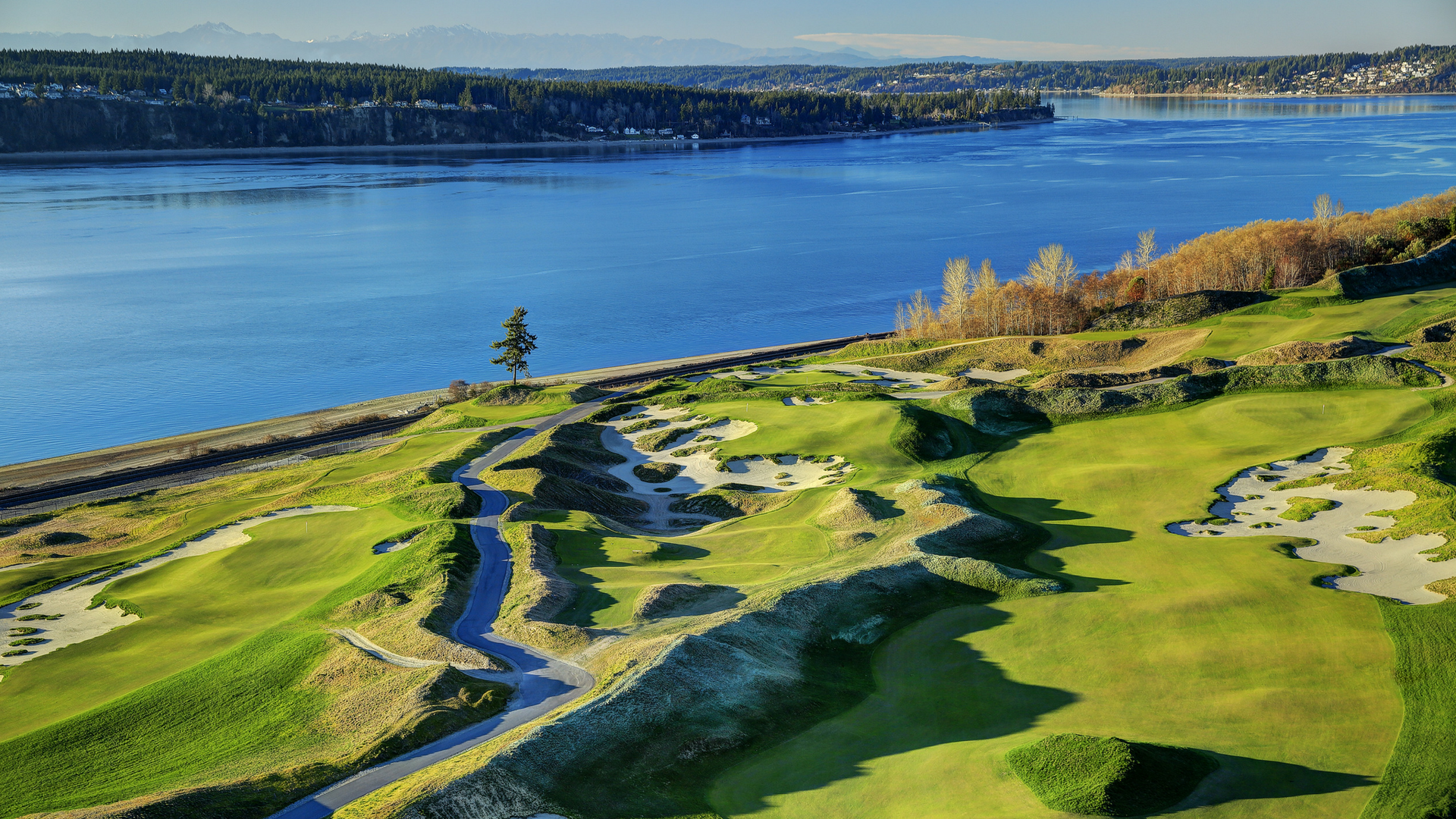
And what a finish! DJ hits the green at the gargantuan 630-yard par-5 finishing hole in two big blows, then three-jacks from 12 to hand the trophy off to Jordan Speith. Shocking.
DJ bounced back the following year in the biggest way the following year, bagging the Open at fabled, venerable Oakmont, Pittsburgh’s great grassy guillotine that will host its record 10th U.S. Open this June. And once again it will enchant and mesmerize one and all with its devilish greens, iconic Church Pew bunkers, and Golden Age design strategies.
Golfers may take home the trophy, but Oakmont always wins the U.S. Open. As it should be at any great Open venue.
In fact, it’s been a bumper crop of phenomenal venues for the U.S. Open of late. If you leave out Erin Hills in 2017, the U.S. Open venues look like a “Murderer’s Row” line up of the old Gas House Gorillas: Chambers, Oakmont, Shinnecock, Pebble Beach, Winged Foot. I’ll take a breath and add Torrey Pines, The Country Club, Los Angeles Country Club, Pinehurst, and then back to Oakmont and Winged Foot.
Let’s contrast the PGA Championship venues over the same time period: Baltusrol, Quail Hollow, Bellerive, Bethpage, Whistling Straits, Kiawah Island, Oak Hill, Southern Hills, Quail Hollow again. There are some bright spots in there: The Hanse renovations at both Tulsa’s Southern Hills and Rochester’s Oak Hill are sublime, enormous upgrades from what they had before. Weak holes or holes designed by intervening architects that clashed with what Perry Maxwell and Donald Ross had originally laid out were crafted to fit with the remainder of the course. Your Author can whole-heartedly recommend that you readers run, not walk, to play them if possible.
But Quail and Bellerive are boring and overrated. They give out great goodie bags at Quail, but that’s about it.
And Bellerive, besides being seven miles from the burning atomic waste dump that houses the radioactive material from the Manhattan Project, is utterly charmless and a pushover. I wrote a long piece not only about how dangerous atomic waste dumps are to visitors of St. Louis, but how generations of cancers have plagued citizens who lived near various spots where the waste was stored. It was well-received for the first 15 minutes of its Sunday morning publication. Then Tiger made four consecutive birdies, vaunted into the lead, and the story was forgotten in a blink.
So anyway, for major venues, I’d say the USGA is closing out the PGA of America 4&2.
Shinnecock was notable for three other reasons. First, just like in 2004 there was controversy involving the speed of the greens on par 3s. While the 2004 debacle at the par-3 second green spelled the beginning of the end of the Tom Meeks running golf course set-up for the U.S. Open (he burned down the second green so badly that they had to spray water on it between groups to keep it playable), they repeated the mistake again in 2018. Once again, the USGA put a pin on a ledge on which a well struck putt would not stop, turning golf into a carnival game.
Second, the broadcasting press tried to manufacture an additional story out of that affair when Phil Mickelson, frustrated with continually missing a putt, struck a moving ball into the hole. Everyone knows that’s a two-stroke penalty. It always has been, it always will be, world without end, Amen. You’ll recall John Daly also took a similar two-stroke penalty in the Open for doing exactly the same thing. Only this time, certain members of the broadcasting press -- interestingly the same out let that unfairly and inaccurately lambasted Chambers Bay -- suddenly started a press campaign that Mickelson should be DQ’d for conduct unbecoming. That evening’s USGA press conference frequently devolved as that issue -- a red herring –- kept getting brought up again despite being contrary to both precedent and ordinary practice. I raised my hand and posited, “Forgive the lawyer for asking this question, but aren’t some people over-lawyering this?”
That’s. Called. Irony!
The third reason Shinny was remarkable was that the upper crust was, as usual, in their most celebratory form. Here was the daily routine I observed first hand from some patrons: get so sloshed in the Bank of America tent that they have to wheel barrow you to your mega-yacht parked just offshore. Sleep off the buzz, then sail the yacht to Fisher’s Island for a quick 27 holes before returning back to the tournament (this time it’s the KPMG tent), to start the process over again. Only tomorrow morning’s round will be at Friar’s Head. Or maybe National. Lather, rinse, repeat.
Typical Shinny: an embarrassment of riches.
How wonderful was it the following year at Pebble to see all-world good guy Gary Woodland celebrating his U.S. Open victory with a little girl with Down’s Syndrome that he became friends with through his foundation work. That’s making everyone around him – including all golf – look good. Quite a contrast to Brooks Koepka, who won the PGA that year in a runaway. Ever the gracious victor – NOT! - Koepka tried to ban quintessential golf writer Alan Shipnuck of Sports Illustrated from the champion’s media interview. First, Koepka’s manager tried to have Ship barred at the interview room door. When that failed and Ship took his seat in the front row, Brooks pointed to him and asked the PGA of America rep conducting the interview to remove Alan form the room.
He did this in front of every journo in the room.
He was rightfully roundly denied.
Ship wrote that he wanted to ask a question but didn’t dare. This is the only time I’ll ever give Ship journalistic advice: You should have. As Tom Auclair taught me as a young, upcoming whippersnapper, “Don’t you ever let them walk all over you. You get right in there and ask another question.”
A good one might be, “Why can’t you win with the same grace and class as Nicklaus or Seve?”
Or perhaps, “If the USA and Saudi Arabia ever come to cross-purposes or God forbid war, whose side are you on? Your nationality or your paymasters?”
Ah yes, the LIV debate. Or is it the LIV debacle? I never can tell. Juvi antics like pouring beers off balconies into patrons’ mouths, shotgun starts, cringe-worthy team names and other kids’ table antic dumb down golf for the casual fan, but the asinine guaranteed fees the players took to turn traitor to the PGA Tour drove up the price of tournament attendance for the fervent golf fan – the game’s lifeblood – to astonishing, in may cases unaffordable levels. $1,000 a day tickets to the Ryder Cup at Bethpage with $15 sodas, $22 beers, and $40 lunch options look downright simoniacal when compared to Augusta National charging $3.75 for the same or similar items.
So, to paraphrase Kurt Vonnegut, speaking of the difference between Armistice Day and Veteran’s Day and about keeping what’s sacred, I’ll keep the PGA Tour and toss the LIV experiment over my shoulder with nary a look back. It was an unholy union formed through greed, selfishness, revenge, and treachery. May there be a hot kettle of fat in hell for Greg Norman for the ignominy he did to our beloved game.
Other than that, for me, this life is just about golf, God and Country -- and sushi, skiing, and tequila as needed. . I refuse to believe that my job is to pray at the Holy Church of the Professional Athlete, it’s to be the eyes ears and conscience of athletic integrity. To have an original, passionate, and observant voice and fight for the ethos and integrity of the game.
For everyone out there with a blog and a dream: I didn’t even start with a dream. But writing made dreams come true for me that I never imagined I could or would have. Read, read, read, and then write, write, write. That’s all you have to do. Reach for the stars, because they are far closer than they appear. And when you catch one, you illuminate the whole world around you.
