


The golf laser rangefinder marketplace can seem pretty crowded. Go on Amazon and search for them, and you'll get scores of products as results -- including many with a disturbing number of consecutive consonants.
There's a reason for that, and it's that the intellectual property behind many laser rangefinder features has expired. So, almost anyone can have one manufactured and sold cheaply. There's something to be said for a cheap laser rangefinder, but there's more to be said for a company that has them made with the right set of features at the right price point.
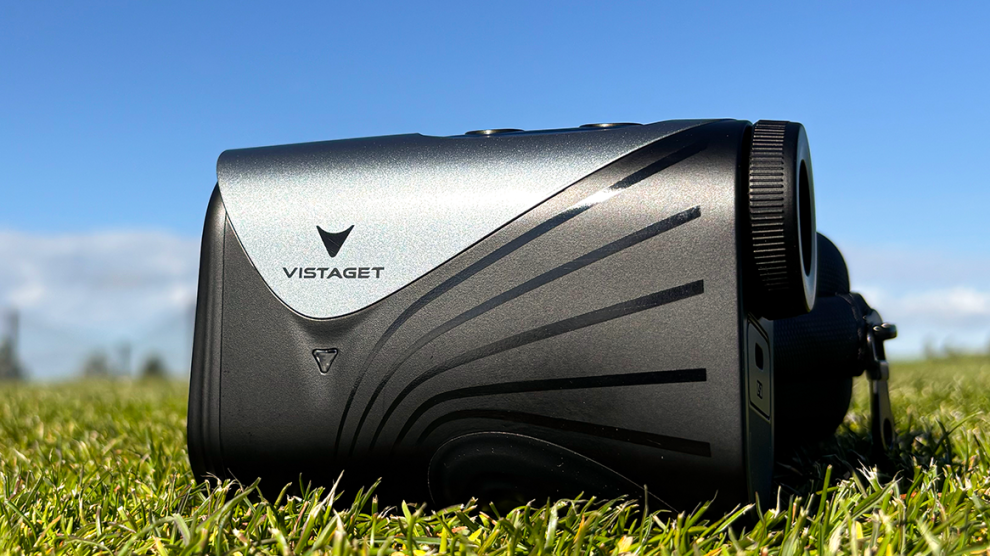
Vistaget is one of the more recent entrants into the space, offering their base Golvia model at under $150. Now, they have a more upscale model, called the Golvia Ultra, at the $300 price point and promising more features that you'd expect on similarly priced models. The company sent it to me recently to try it out on the golf course.
The Golvia Ultra comes with the usual features, and they work well. There's a black display on an LCD screen (red is better for my eye, but there are split tastes here), and the presentation clearly shows actual and plays-like distances when the slope feature is used. Having recently used a unit that only shows the plays-like number when slope is turned on, I'm happy that this unit shows the actual and plays-like numbers, as well as the adjustment distance.
As has become universal, the slope function can be turned off with the press of a button to engage Tournament Mode, and, when the slope is on, the unit has a red light on the side to indicate that.
The display also shows club recommendations based on the distance and the temperature, humidity and altitude at the time of the shot. The caddie suggestions aren't factoring in data from a launch monitor or anything like that, but it's not getting in the way, and the user can adjust the approximate distances for each club, within a certain range of yardages, to make the recommendations more meaningful. The conditions consideration is certainly helpful, though more experienced golfers should also know that the ball goes farther when its hotter, more humid and hit at a higher elevation. (Like slope, the weather-considered distance suggestions also turn off when Tournament Mode is used.)
The response time from trigger to display is quick for the class, which is great to see. The trigger and mode buttons do seem a little too close together, and they're both circular, so it may lead to some mix-ups.
The unit's best feature is the SteadyTrack optical image stabilization. I had (and still have) a Canon laser rangefinder that did this, and it made it so much easier to get a good number on the first try, even when I only had one hand on the unit. The stabilization can seem a little glitchy at first because it does adjust on the fly, but it's a feature you'll quickly appreciate if you've never seen it.
The other standout feature is distance triangulation. The Golvia Ultra allows the user to stand in one position and then measure the distance of two separate objects to determine the distance between them. There are peers in this space that have this feature, but the Vistaget version is quick and easy to use.
The Golvia Ultra also has a scanning feature where the unit looks for a flag or pin amid the landscape while slowly moving the unit across. This is particularly helpful if you're struggling to see the flag or if you're having trouble catching it on your own. When the flag or pin is identified and measured, there's an audio and visual indicator of that happening. Sometimes, the functionality can be inaccurate, as the unit is looking for items in the foreground that stand out from the sky and background. This can happen on other units as well, so the user must be cognizant of that.
The eyepiece itself offers a little longer eye relief, so that can help golfers who play with glasses or struggle to see through the eyepiece. It's a small but nice touch, particularly for those of us with vision issues.
The unit has a cart magnet, IP65 water resistance, and it has a two-year warranty. The battery is charged by USB-C cable. I think most golfers prefer shoving a battery in there and calling it a day for a few years, but the space the battery occupies is more of a consideration than ever in these feature-packed units. The space and weight matters, so Vistaget went with the USB charger here. Unfortunately, that charging port does not have a cover, leaving it open to wind and water.
The Vistaget Golvia Ultra comes in at $299.
The Pros: The image-stabilization feature is probably worth that extra cost to someone who can struggle to keep their hands steady. The triangulation feature is most useful for cart riders who might be playing on a CPO (cart part only) day, but it can be helpful in other situations. The response time is quick.
The Cons: The USB-C charger is open to the weather. The club recommendations have very limited use because they're locked into a range of distances and based on the user's understanding of their distances, which golfers are notoriously bad at knowing. A red display would be best, but the wider lens and eyepiece relief are nice.
