


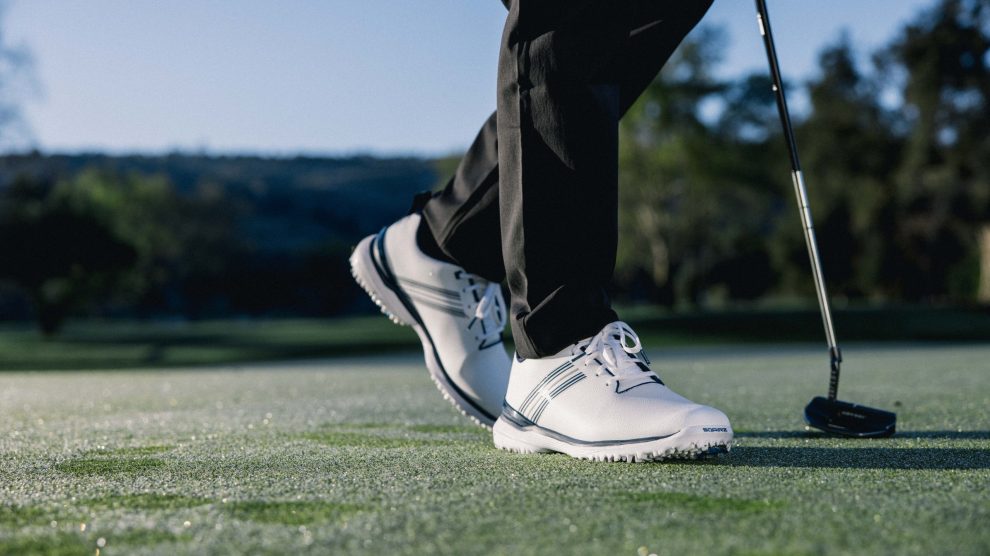
We spend countless hours working on our golf swing. We analyze club paths, launch angles, rotation, sequencing, balance, and ground reaction forces. We invest in better clubs, better training, and better instruction, all in pursuit of more distance, greater consistency, and improved control.
But in my experience working with athletic performance and movement, one part of the equation deserves far more attention: the connection between your feet, your footwear, and the ground.
At Sqairz, we approach golf footwear from an athletic performance perspective. We believe a golf shoe should do more than provide traction and look good. Its design should consider how the foot functions, how the body moves, and how the golfer interacts with the ground throughout the swing.
Two features are central to that conversation: heel-to-toe drop and toe-box geometry.
Understanding how these features work together can change how you think about the role your golf shoes play in your game.
Heel-to-toe drop: Start with the foundation
Heel-to-toe drop is the difference in height between the heel and forefoot of a shoe. A zero-drop shoe places both at the same height, while a shoe with an 8–11 mm drop elevates the heel relative to the forefoot.
That difference matters because the foot doesn’t function in isolation. Its position influences the demands placed on the ankle, knee, hip, and trunk.
One of the most important components is ankle dorsiflexion, the ability of the shin to move forward over the foot.
Dorsiflexion contributes to many athletic movements, including squatting, lunging, and managing lower-body positions. When that motion is restricted, the body may compensate elsewhere to accomplish the task.
In golf, those compensations can influence how a player establishes address posture, manages pressure shifts, rotates the pelvis, and maintains balance.
This doesn’t mean every golfer with restricted dorsiflexion will have a swing problem. But it does mean that ankle mobility and footwear geometry deserve consideration when evaluating how a golfer moves.
A heel-to-toe drop changes the ankle’s starting position and can reduce the dorsiflexion required in certain movements. It doesn’t restore lost mobility, but it will help golfers of all levels access positions more comfortably and efficiently.
At Sqairz, we believe footwear should work with the athlete’s movement demands, not create unnecessary obstacles to them.
Want to understand the difference? Try the squat test.
Here’s a simple demonstration I use to illustrate how foot position can influence movement.
Stand with your feet about shoulder-width apart and perform a bodyweight squat with your toes elevated on, say, a brick or piece of wood and your heels on the floor. Pay attention to your balance, depth, and how your body organizes itself.
Now reverse the setup. Place your heels on that same surface, with your forefeet on the ground, and squat again.
For many people, the heel-elevated position makes it easier to reach greater depth while keeping the torso more upright.
Why?
Elevating the heels changes the ankle angle and the relative demands placed on the ankle, knees, hips, and trunk. It can make the squat more accessible for people whose available dorsiflexion otherwise limits the movement.
This is one reason heel elevation is commonly used in certain strength-training exercises and why weightlifting shoes often incorporate a raised heel.
To be clear, raising your toes isn’t exactly the same as wearing zero-drop footwear, and a squat isn’t a golf swing. But the demonstration illustrates an important principle: changing the position of the foot can change how the entire body moves.
If foot position influences a fundamental movement like the squat, shouldn’t we pay closer attention to it in a sport that demands precise balance, rotation, sequencing, and force application?
I certainly think so.
Why heel elevation deserves a place in the athletic performance conversation
Spend time around strength and conditioning professionals and you’ll see athletes using heel-elevated squats, weightlifting shoes, and slant boards as part of their training.
The objective isn’t necessarily to avoid ankle mobility work. It’s to position the body appropriately for the task being trained.
Heel elevation can help certain athletes achieve the positions required for an exercise while maintaining balance and allowing them to focus on the intended movement.
That doesn’t mean a raised heel is always better, or that every athlete should wear elevated-heel footwear for every sport. Athletic performance depends on the individual, the task, and the complete footwear design.
But it challenges the assumption that a level heel-to-toe profile is automatically the ideal starting point for every athlete.
Golf is a particularly interesting example. The golfer needs a stable base while shifting pressure, rotating the pelvis and trunk, and transferring force through the swing.
The question isn’t simply whether the heel and forefoot are level. It’s whether the shoe’s geometry supports the golfer’s movement requirements.
Why Sqairz focuses on an 8–11 mm heel-to-toe drop
At Sqairz, our design philosophy focuses on how the shoe supports the athlete from the ground up. Our 8–11 mm heel-to-toe drop target reflects our approach to creating a functional foundation for athletic movement.
We want golfers to have the opportunity to establish a stable base, manage balance, and coordinate movement without asking their bodies to work around unnecessary footwear limitations.
But I want to emphasize something: the heel drop is only one part of the equation.
No single measurement guarantees better sequencing, increased clubhead speed, or more distance for every golfer. Individual ankle mobility, swing mechanics, shoe construction, traction, and fit all influence the result.
What matters is how the complete design works with the golfer.
And this brings us to a feature I believe is just as important as heel drop, and one that is often overlooked in golf footwear.
The toe box: The missing piece in the performance equation
Getting the heel-to-toe drop right is only part of the equation. To understand footwear performance, you must also consider how the foot connects to the ground, and how securely it remains positioned inside the shoe.
Think of the foot as your body’s anchoring system. It is your connection to the ground, helping you manage pressure, maintain balance, and generate and control forces during movement. The toes and forefoot play an important role in this system by contributing to balance, adapting to changing demands, and helping establish a functional base of support.
But an anchor can only function as intended when the foot has room to work.
When a shoe’s toe box is too narrow, it can crowd the toes and restrict their ability to spread naturally. Depending on the individual and the degree of compression, this may limit the foot’s ability to assume an efficient, functional position within the shoe.
That is why toe-box geometry matters.
The Square Toe Box: Room to Establish Your Base
The Sqairz square toe box is designed to provide additional room in the forefoot, allowing the toes to spread more naturally within the shoe. This helps accommodate the foot’s natural shape and supports the toes’ contribution to a functional base of support.
In golf, that base is especially important. During the swing, the golfer must manage changing ground-reaction forces while rotating, transferring pressure, and maintaining postural control. The feet serve as the interface between the golfer and the ground, helping the body respond to these forces throughout the movement.
The toe box is an extremely important part of that anchoring system, but it does not work alone.
The lacing system helps secure the midfoot. The heel structure helps retain the rearfoot. The nonslip insole helps limit sliding between the foot and the shoe. Meanwhile, the square toe box provides room for the forefoot rather than unnecessarily constraining it.
Together, these features are designed to help the foot remain securely positioned within the shoe while accommodating its natural shape and supporting the demands of the golf swing.
Heel drop is one variable. The Foot-Shoe Interface is the system.
Heel-to-toe drop influences how the foot is positioned inside the shoe, but it is only one element of footwear design. A complete approach to performance must also consider how the shoe accommodates the forefoot, secures the midfoot, retains the heel, and maintains the connection between the foot and the shoe.
At Sqairz, the square toe box reflects a fundamental principle: a functional anchoring system starts with a foot that has room to function.
How the toe box can influence the rest of the body
Let’s connect the foot to what actually happens during the golf swing.
At address, the golfer establishes a base of support. During the backswing, pressure shifts as the body loads. In transition, the golfer reorganizes pressure and begins accelerating the club through a coordinated sequence of lower-body and upper-body movement. Through impact and follow-through, the golfer must continue managing balance as the body rotates.
The feet provide the physical connection to the ground throughout this process.
The heel, forefoot, and toes contribute to that connection, while the shoe influences the space available to the foot, the support beneath it, and the traction it can generate.
A toe box that accommodates the natural shape of the foot can help preserve comfortable toe positioning. Combined with an appropriate heel drop and a stable platform, it can support the conditions needed for effective balance and movement.
This doesn’t mean a wider toe box automatically creates more power or that toe-box shape alone controls pelvic rotation. The connection is more nuanced: the shoe influences the environment in which the golfer establishes balance, manages pressure, and coordinates movement.
And those are important components of the golf swing.
Think about it this way: if you’re trying to build an efficient kinetic chain, why would you ignore the first point of contact with the ground?
The foot is the foundation. The ankle, knee, hip, pelvis, and trunk all contribute to the movement that follows. While no single shoe feature dictates how those segments work together, footwear can either accommodate the foot or introduce constraints that deserve attention.
This is why Sqairz considers toe-box design a performance feature, not simply a cosmetic difference.
Matching heel drop isn’t enough
Some golf shoes may offer a similar heel-to-toe drop. But matching one measurement doesn’t make two shoes biomechanically equivalent.
The Complete Shoe Design Matters
Every element of a golf shoe contributes to how the foot interacts with the ground and how the body moves throughout the swing.
Heel-to-toe drop: Changes the relative height of the heel and forefoot, positively influencing ankle mechanics and movement demands during ground-based athletic activities.
Toe-box geometry: Influences how the foot is positioned and supported within the shoe, optimizing the athlete’s base of support, stability, balance, and posture, and how these factors interact with movement throughout the body.
Platform stability: Influences how the foot is supported as pressure shifts and the golfer manages postural sway throughout the swing.
Traction: Helps the golfer maintain grip with the ground while rotating and applying force during the swing.
Fit and comfort: Influence how securely and naturally the foot sits inside the shoe, supporting comfortable movement and consistent interaction with the ground.
These features work together. A shoe with a potentially useful heel drop but a toe box that compresses the forefoot will not provide the overall fit and support that golfer needs.
This is where Sqairz differentiates its design philosophy. We don’t view heel drop as an isolated number. We consider how heel elevation, toe-box shape, platform stability, and traction work together to support the demands of the game.
The objective is a shoe that accommodates the foot while supporting the golfer’s movement, not simply a shoe that checks a box on a specification sheet.
What Gray Cook and functional movement teach us
Gray Cook, co-founder of Functional Movement Systems, has helped bring greater attention to movement quality and the importance of identifying mobility limitations rather than simply training around them.
Ankle dorsiflexion is one of the mobility factors commonly assessed because it can influence squatting, lunging, and other functional movements.
The broader lesson applies to golf: when a golfer struggles to achieve a position, we should consider the underlying movement demands before assuming the solution is simply more practice or a swing adjustment.
Limited dorsiflexion is not the only explanation for movement difficulties, and raising the heel doesn’t correct the underlying mobility restriction. But footwear can change the demands placed on the ankle and will help all golfers access positions more efficiently.
That is why I believe golf footwear should be considered alongside mobility, movement assessment, swing mechanics, and equipment fitting.
At Sqairz, we want to advance that conversation by asking a better question: how can footwear be designed around the way the human foot functions and the way the athlete needs to move?
The competitive advantage starts beneath your feet
Golfers will spend thousands of dollars searching for more distance, better consistency, and improved performance. They’ll analyze launch monitors, test drivers, compare shafts, and work tirelessly on their swings.
Yet the footwear connecting them to the ground often receives far less scrutiny.
I believe that deserves to change.
The right footwear won’t replace instruction, strength, mobility, or sound swing mechanics. But footwear design influences the environment in which a golfer performs.
At Sqairz, our philosophy is built around that connection.
We consider heel-to-toe drop because foot position matters. We consider toe-box geometry because the foot’s natural shape matters. And we consider stability and traction because the golfer needs a reliable connection with the ground throughout the swing.
These aren’t isolated design decisions. They’re pieces of a larger performance equation.
For me, the takeaway is simple: if we’re serious about improving athletic performance, we should pay attention to the foundation that supports every movement.
Your golf swing doesn’t start at the clubhead. It starts with your connection to the ground.
And that connection starts with your shoes.
About the Author: Philip Stotter, MS, CEP
Philip Stotter is an industry leader in sports science and applied biomechanics, bringing a clinical background and three decades of professional experience, including work in Major League Baseball (MLB) and the National Football League (NFL). A researcher, inventor, keynote speaker, and consultant, Philip has collaborated with leading organizations and brands, including Wilson Sporting Goods, EvoShield, V1 Sports, PGA TOUR Superstore, and Mayo Clinic, among others. Since his introduction to Sqairz in 2020, Philip has helped shape the brand’s direction and champion its science-driven approach to athletic footwear. His work reflects a commitment to understanding the relationship between footwear design, human movement, and the ground forces that influence athletic performance.
